In
yesterday's post, I presented
three different methods for analyzing recovery tests. Today, I will focus on the
Agarwal recovery method which has been used by petroleum engineers for over 30 years. Agarwal (1980) devised a simple yet powerful data transformation for the interpretation of recovery tests. The transformation, known as Agarwal equivalent time, allows one to analyze recovery data with standard type curves developed for drawdown data.
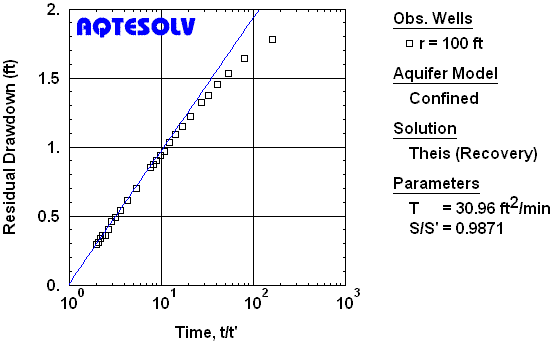
The following figure illustrates the simplicity of the Agarwal method in the analysis of a recovery test. In this example, I matched the familiar Theis type curve, normally applied to drawdown data, to estimate aquifer properties from recovery test data (USBR 1995).
 |
| Agarwal recovery analysis using Theis (1935) solution. |
Many different pumping test solutions may be used in conjunction with the Agarwal technique as well as diagnostic methods such as
derivative analysis. The figure below shows recovery and derivative data matched together with the Cooper-Jacob straight-line solution.
 |
| Agarwal recovery analysis using Cooper-Jacob (1946) solution with derivative. |
Recovery test analysis with the Agarwal equivalent-time method is available in
AQTESOLV v4.x. This
advanced aquifer test analysis software allows you to estimate aquifer properties by matching both recovery and derivative data together.
Learn more about the
Agarwal method in
Aquifer Testing 101 at the
AQTESOLV web site.