Upon its release in 2006, AQTESOLV/Pro v4.0 became the first aquifer testing software to feature groundwater mounding calculators that predict the transient rise and decay of the water table beneath rectangular and circular recharge areas (Hantush 1967). Using AQTESOLV, you may compute the maximum rise of the water table and generate contours of a groundwater mound with ease.
The example plot (above) shows a 3-D contour plot of a groundwater mound developed around a hypothetical rectangular recharge area. Applications for the groundwater mounding calculators in AQTESOLV include infiltration from septic systems and recharge from stormwater impoundments.
Visit the AQTESOLV web site for more information on the Hantush (1967) solutions for groundwater mounding prediction.
Sunday, November 1, 2009
Saturday, June 20, 2009
ASTM "Standards"
ASTM publishes "standards" on many subjects including aquifer test analysis. ASTM D5912-96 (2004) entitled Standard Test Method for (Analytical Procedure) Determining Hydraulic Conductivity of an Unconfined Aquifer by Overdamped Well Response to Instantaneous Change in Head (Slug) is one such ASTM standard. You'll spend $32 to obtain a copy of this four-page standard from ASTM, but don't expect to get completely accurate information for your investment.
ASTM D5912-96 (2004) describes a widely used method of slug test analysis devised by Bouwer and Rice (1976). The standard contains an equation (ASTM D5912-96 (2004), p. 2, Equation [2]) used in the Bouwer and Rice method to calculate the parameter ln(Re/rw) when D (the aquifer thickness) is greater than H (the penetration of the well) as follows:

The ln(Re/rw) parameter is used in the Bouwer and Rice method to calculate the hydraulic conductivity K from a slug test.
Unfortunately, the above equation from ASTM D5912-96 (2004) is incorrect. The correct form of this equation (Bouwer and Rice 1976, p. 425, Equation [8]) is written as follows:

As one can see from a comparison the two foregoing equations, the ASTM version misplaces the term L/rw and leads to a completely erroneous estimate of ln(Re/rw).
Am I just nitpicking here? I don't think so. It's hardly unreasonable to expect thorough attention to detail from a publication put forth as a "standard" such as ASTM D5912-96 (2004). Certainly, the basic equations that are central to such a standard should be checked carefully and published without error. ASTM standards purportedly go through a rigorous review process. Yet ASTM D5912-96 (2004), adopted in 1996 and subsequently reapproved in 2004, still contains the flawed equation. One is left to wonder how many other "standards" relied upon for aquifer testing contain similar fundamental errors.
ASTM D5912-96 (2004) describes a widely used method of slug test analysis devised by Bouwer and Rice (1976). The standard contains an equation (ASTM D5912-96 (2004), p. 2, Equation [2]) used in the Bouwer and Rice method to calculate the parameter ln(Re/rw) when D (the aquifer thickness) is greater than H (the penetration of the well) as follows:

The ln(Re/rw) parameter is used in the Bouwer and Rice method to calculate the hydraulic conductivity K from a slug test.
Unfortunately, the above equation from ASTM D5912-96 (2004) is incorrect. The correct form of this equation (Bouwer and Rice 1976, p. 425, Equation [8]) is written as follows:

As one can see from a comparison the two foregoing equations, the ASTM version misplaces the term L/rw and leads to a completely erroneous estimate of ln(Re/rw).
Am I just nitpicking here? I don't think so. It's hardly unreasonable to expect thorough attention to detail from a publication put forth as a "standard" such as ASTM D5912-96 (2004). Certainly, the basic equations that are central to such a standard should be checked carefully and published without error. ASTM standards purportedly go through a rigorous review process. Yet ASTM D5912-96 (2004), adopted in 1996 and subsequently reapproved in 2004, still contains the flawed equation. One is left to wonder how many other "standards" relied upon for aquifer testing contain similar fundamental errors.
Tuesday, April 28, 2009
AQTESOLV in Boston
Today marks the beginning of our three-day Advanced Aquifer Testing Techniques Featuring AQTESOLV: New Concepts, Field Methods and Data Analysis Procedures short course at the Waltham Wood Conference Center outside of Boston, MA. Presented in cooperation with the Midwest Geosciences Group, we have been offering this course every year since 2006. The course covers aquifer testing topics pertaining to slug tests and pumping tests. As part of each day's activities, course participants gain hands-on experience with the AQTESOLV software using data from real-life field investigations conducted in a variety of hydrogeologic settings.
Last year (2008) seemed to come and go very quickly owing to an extremely busy schedule! We presented our three-day aquifer testing course featuring AQTESOLV in San Antonio, TX to a large audience and also taught well-attended two-day seminars in Waterloo, ON, Canada as well as Ft. Collins, CO. A wonderfully exciting time for me was a three-week period in November and December 2008 when I traveled to Australia to participate in the instruction of short courses on fractured bedrock in Melbourne and Sydney.
Monday, December 31, 2007
Wellfield Simulations
This will be my last post for 2007, so let me begin by expressing my sincere appreciation and gratitude to all of you who have either become new AQTESOLV customers or continued to support the software by upgrading in the past year. As always I'm working hard to add new features that will maintain AQTESOLV's status as the leading software for aquifer test analysis.
As many of you already know, AQTESOLV includes the capability to model more than one pumping well in either pumping test analyses or predictive simulations. You may enter a variable pumping rate schedule for each well. For example, you can use the multiple pumping well feature to predict total drawdown in a wellfield as shown in the contour plot.
Another use of this multi-well feature would be to include the effect of more than one pumping well in the analysis of a pumping test (e.g., a domestic well that turns on and off during your test). Image wells can be simulated in the same way.
Best wishes for a happy and healthy New Year!
As many of you already know, AQTESOLV includes the capability to model more than one pumping well in either pumping test analyses or predictive simulations. You may enter a variable pumping rate schedule for each well. For example, you can use the multiple pumping well feature to predict total drawdown in a wellfield as shown in the contour plot.
Another use of this multi-well feature would be to include the effect of more than one pumping well in the analysis of a pumping test (e.g., a domestic well that turns on and off during your test). Image wells can be simulated in the same way.
Best wishes for a happy and healthy New Year!
Labels:
features,
multiple pumping wells,
prediction,
tips,
wellfield simulation
Sunday, December 9, 2007
NGWA Expo in Orlando
On Thursday, December 6, I swooped into Orlando, FL for a brief visit to the 2007 NGWA Ground Water Expo held at the Orlando County Convention Center. In the afternoon, I gave an invited oral presentation entitled Aquifer Test Analysis: A Modern Approach as part of a special technical session on "Advances in the Water Well Industry Over the Past 20 Years" moderated by Bob Sterrett and John Jansen.
In my talk, I emphasized the important role of specialized computer software such as AQTESOLV in the analysis of aquifer test data. Particular advantages of computer-assisted analysis over traditional methods of interpretation include diagnostic tools (diagnostic flow plots and derivative analysis); choice of curve matching method (visual and automatic); and statistical methods for interpreting results. In addition, the most recently published mathematical solutions are simply not well suited to graphical analysis using type curve techniques due to the large number of type curves required for their application. Consequently, a modern approach to aquifer test analysis takes advantage of the power afforded by today’s specialized software.
Friday, October 26, 2007
From Ft. Collins to Ottawa
We had another successful aquifer testing course featuring AQTESOLV at the headquarters of In-Situ, Inc. this year. The sold-out course was attended by a lively group of professionals who came to learn more about conducting and analyzing slug tests and pumping tests. Many thanks to In-Situ for hosting us at their facility in Ft. Collins, Colorado!
Right after the course in Ft. Collins, I traveled to Ottawa, Ontario, Canada to participate in a seminar taught by Christopher Neville (pictured at right with Jeff Simpson) at the 60th Canadian Geotechnical Conference/8th Joint CGS/IAH-CNC Groundwater Specialty Conference entitled Critical Thinking in Pumping Test Interpretation. I contributed a module on diagnostic methods applied to the analysis of pumping tests which covered the use of diagnostic flow plots and derivative analysis in the identification of different flow regimes that emerge in the course of pumping tests. Thanks to Chris for inviting me to participate in his great course!

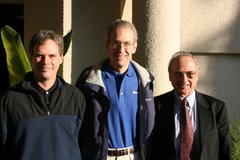
On my second day in Ottawa, I joined Jeff Simpson from Aquatic Life, Ltd. in the exhibitors' area of the conference. Aquatic Life rents and sells environmental monitoring equipment including In-Situ sensors for pressure and water-quality parameters. In an earlier post, I wrote about our collaboration with Aquatic Life in presenting an aquifer testing course in Calgary, Alberta. It was great to work with Jeff again!
Wednesday, October 3, 2007
Full House in Ft. Collins!
I'm pleased to report that we've once again filled our short course in Ft. Collins, CO to maximum capacity before the early registration deadline. Last year was our first time in Ft. Collins so we're now 2-for-2!
We're holding the two-day short course entitled Aquifer Testing for Improved Hydrogeologic Site Characterization Featuring AQTESOLV and the In-Situ Level TROLL at the headquarters of In-Situ, Inc. on October 16 and 17, 2007. The course will include presentations by Jim Butler and myself on topics relating to slug tests and pumping tests and also will give everyone the opportunity to use AQTESOLV in the hands-on analysis of real-world test data.
Thanks to everyone who registered for the course. I look forward to meeting all of you!
We're holding the two-day short course entitled Aquifer Testing for Improved Hydrogeologic Site Characterization Featuring AQTESOLV and the In-Situ Level TROLL at the headquarters of In-Situ, Inc. on October 16 and 17, 2007. The course will include presentations by Jim Butler and myself on topics relating to slug tests and pumping tests and also will give everyone the opportunity to use AQTESOLV in the hands-on analysis of real-world test data.
Thanks to everyone who registered for the course. I look forward to meeting all of you!
Subscribe to:
Posts (Atom)

