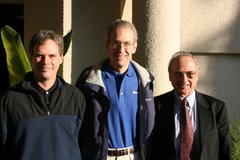
On Thursday, December 6, I swooped into Orlando, FL for a brief visit to the 2007 NGWA Ground Water Expo held at the Orlando County Convention Center. In the afternoon, I gave an invited oral presentation entitled Aquifer Test Analysis: A Modern Approach as part of a special technical session on "Advances in the Water Well Industry Over the Past 20 Years" moderated by Bob Sterrett and John Jansen.
In my talk, I emphasized the important role of specialized computer software such as AQTESOLV in the analysis of aquifer test data. Particular advantages of computer-assisted analysis over traditional methods of interpretation include diagnostic tools (diagnostic flow plots and derivative analysis); choice of curve matching method (visual and automatic); and statistical methods for interpreting results. In addition, the most recently published mathematical solutions are simply not well suited to graphical analysis using type curve techniques due to the large number of type curves required for their application. Consequently, a modern approach to aquifer test analysis takes advantage of the power afforded by today’s specialized software.
Sunday, December 9, 2007


Friday, October 26, 2007
From Ft. Collins to Ottawa
We had another successful aquifer testing course featuring AQTESOLV at the headquarters of In-Situ, Inc. this year. The sold-out course was attended by a lively group of professionals who came to learn more about conducting and analyzing slug tests and pumping tests. Many thanks to In-Situ for hosting us at their facility in Ft. Collins, Colorado!
 Right after the course in Ft. Collins, I traveled to Ottawa, Ontario, Canada to participate in a seminar taught by Christopher Neville (pictured at right with Jeff Simpson) at the 60th Canadian Geotechnical Conference/8th Joint CGS/IAH-CNC Groundwater Specialty Conference entitled Critical Thinking in Pumping Test Interpretation. I contributed a module on diagnostic methods applied to the analysis of pumping tests which covered the use of diagnostic flow plots and derivative analysis in the identification of different flow regimes that emerge in the course of pumping tests. Thanks to Chris for inviting me to participate in his great course!
On my second day in Ottawa, I joined Jeff Simpson from Aquatic Life, Ltd. in the exhibitors' area of the conference. Aquatic Life rents and sells environmental monitoring equipment including In-Situ sensors for pressure and water-quality parameters. In an earlier post, I wrote about our collaboration with Aquatic Life in presenting an aquifer testing course in Calgary, Alberta. It was great to work with Jeff again!
 Right after the course in Ft. Collins, I traveled to Ottawa, Ontario, Canada to participate in a seminar taught by Christopher Neville (pictured at right with Jeff Simpson) at the 60th Canadian Geotechnical Conference/8th Joint CGS/IAH-CNC Groundwater Specialty Conference entitled Critical Thinking in Pumping Test Interpretation. I contributed a module on diagnostic methods applied to the analysis of pumping tests which covered the use of diagnostic flow plots and derivative analysis in the identification of different flow regimes that emerge in the course of pumping tests. Thanks to Chris for inviting me to participate in his great course!
On my second day in Ottawa, I joined Jeff Simpson from Aquatic Life, Ltd. in the exhibitors' area of the conference. Aquatic Life rents and sells environmental monitoring equipment including In-Situ sensors for pressure and water-quality parameters. In an earlier post, I wrote about our collaboration with Aquatic Life in presenting an aquifer testing course in Calgary, Alberta. It was great to work with Jeff again!
Wednesday, October 3, 2007
Full House in Ft. Collins!
I'm pleased to report that we've once again filled our short course in Ft. Collins, CO to maximum capacity before the early registration deadline. Last year was our first time in Ft. Collins so we're now 2-for-2!
We're holding the two-day short course entitled Aquifer Testing for Improved Hydrogeologic Site Characterization Featuring AQTESOLV and the In-Situ Level TROLL at the headquarters of In-Situ, Inc. on October 16 and 17, 2007. The course will include presentations by Jim Butler and myself on topics relating to slug tests and pumping tests and also will give everyone the opportunity to use AQTESOLV in the hands-on analysis of real-world test data.
Thanks to everyone who registered for the course. I look forward to meeting all of you!
We're holding the two-day short course entitled Aquifer Testing for Improved Hydrogeologic Site Characterization Featuring AQTESOLV and the In-Situ Level TROLL at the headquarters of In-Situ, Inc. on October 16 and 17, 2007. The course will include presentations by Jim Butler and myself on topics relating to slug tests and pumping tests and also will give everyone the opportunity to use AQTESOLV in the hands-on analysis of real-world test data.
Thanks to everyone who registered for the course. I look forward to meeting all of you!
Friday, August 17, 2007
Day 2 in Calgary....
 Yesterday evening, Jeff Simpson (right) of Aquatic Life generously invited everyone attending the short course in Calgary to a local pub for refreshment and dinner. We had a great time getting to know people, learning about their work and discussing a wide range of topics. Many thanks to Aquatic Life!
Today we are covering pumping tests in the course. After an introduction to the design and performance of pumping tests by Jim Butler, Chris Neville and I will present some of the finer details of pumping test analysis such as diagnostics methods, single-well tests, step-drawdown tests and recovery tests, analysis of tests in buried channel (strip) aquifers, and new methods for analyzing pumping tests in unconfined aquifers.
In the afternoon, the class will perform computer exercises with AQTESOLV demonstrating the analysis of pumping tests in confined, leaky confined, unconfined and fractured aquifers. This year's course features a new exercise for a pumping test conducted in a buried channel aquifer in Saskatchewan, Canada.
To all of you who joined us in Calgary for this course, we thank you for coming! It's been a pleasure interacting with you over the last two days.
Thursday, August 16, 2007
Stampeding into Calgary!
Today marks the beginning of our two-day short course entitled Aquifer Testing for Improved Hydrogeologic Site Characterization Featuring AQTESOLV and the In-Situ Level TROLL at the University of Calgary in Canada. I'm extremely pleased to report that we reached maximum capacity in our first-ever attempt to conduct this course outside the US. Kudos to Aquatic Life and the Midwest Geosciences Group making this groundbreaking course a great success!
 I'm joined in this course by two distinguished colleagues, Jim Butler (Kansas Geological Survey) and Chris Neville (S.S. Papadopulos & Associates). Today, we're covering slug tests through a combination of lectures and computer exercises involving AQTESOLV. As I compose this blog entry, Jim is describing the application and advantages of the pneumatic method of initiating slug tests which is still a new technique for many practicing hydrogeologists. In his lectures today, Jim will present many new tidbits of practical advice from his ongoing research that are not included in his book The Design, Performance, and Analysis of Slug Tests (Butler 1998).
In the afternoon, Jeff Simpson from Aquatic Life will demonstrate the application of pressure transducer equipment in the performance of slug tests and stress pitfalls to avoid when conducting these tests. Following Jeff's presentation, I'll lead the class through the hands-on computer analysis of slug tests using AQTESOLV.
It's a great day and great venue here at the University of Calgary. Many thanks to all those who came to attend the course!
 I'm joined in this course by two distinguished colleagues, Jim Butler (Kansas Geological Survey) and Chris Neville (S.S. Papadopulos & Associates). Today, we're covering slug tests through a combination of lectures and computer exercises involving AQTESOLV. As I compose this blog entry, Jim is describing the application and advantages of the pneumatic method of initiating slug tests which is still a new technique for many practicing hydrogeologists. In his lectures today, Jim will present many new tidbits of practical advice from his ongoing research that are not included in his book The Design, Performance, and Analysis of Slug Tests (Butler 1998).
In the afternoon, Jeff Simpson from Aquatic Life will demonstrate the application of pressure transducer equipment in the performance of slug tests and stress pitfalls to avoid when conducting these tests. Following Jeff's presentation, I'll lead the class through the hands-on computer analysis of slug tests using AQTESOLV.
It's a great day and great venue here at the University of Calgary. Many thanks to all those who came to attend the course!
Sunday, August 12, 2007
AQTESOLV Version 4.5 is Here!
I'm pleased to announce the release of AQTESOLV v4.5, the world's leading software for the analysis of pumping tests, slug tests and constant-head tests since 1989.
AQTESOLV/Pro v4.5 is the first commercially available software for aquifer test analysis to feature a new analytical solution by Tartakovsky and Neuman (2007). Unlike the familiar method by Neuman (1974) for pumping tests in unconfined aquifers, the Tartakovsky-Neuman solution incorporates effects of 3-D saturated/unsaturated flow to account for noninstantaneous drainage at the water table. I've optimized the numerical computations in AQTESOLV to maximize the speed and accuracy of this complicated solution.
 Shown at right is a match of drawdown and derivative curves that I obtained with AQTESOLV's implementation of the Tartakovsky and Neuman solution for an observation well monitored during a pumping test on Cape Cod by the USGS (Moench et al. 2001). Note the response at intermediate time which shows gradual rather instantaneous drainage of water.
Also featured in AQTESOLV/Pro v4.5 is a version of the Dougherty and Babu (1984) finite-diameter well solution adapted for the analysis of step-drawdown tests. Unlike traditional methods for analyzing step tests, the Dougherty-Babu step-test solution considers the effect of wellbore storage on early-time drawdown data measured in the pumped well. It also accounts for partial penetration, wellbore skin and turbulent well loss. One of my customers has already applied this solution with excellent results!
AQTESOLV v4.5 comes with interface enhancements and a revised Help system to increase productivity. For more information or to order the software, please visit the AQTESOLV web site or contact me directly!
AQTESOLV/Pro v4.5 is the first commercially available software for aquifer test analysis to feature a new analytical solution by Tartakovsky and Neuman (2007). Unlike the familiar method by Neuman (1974) for pumping tests in unconfined aquifers, the Tartakovsky-Neuman solution incorporates effects of 3-D saturated/unsaturated flow to account for noninstantaneous drainage at the water table. I've optimized the numerical computations in AQTESOLV to maximize the speed and accuracy of this complicated solution.
 Shown at right is a match of drawdown and derivative curves that I obtained with AQTESOLV's implementation of the Tartakovsky and Neuman solution for an observation well monitored during a pumping test on Cape Cod by the USGS (Moench et al. 2001). Note the response at intermediate time which shows gradual rather instantaneous drainage of water.
Also featured in AQTESOLV/Pro v4.5 is a version of the Dougherty and Babu (1984) finite-diameter well solution adapted for the analysis of step-drawdown tests. Unlike traditional methods for analyzing step tests, the Dougherty-Babu step-test solution considers the effect of wellbore storage on early-time drawdown data measured in the pumped well. It also accounts for partial penetration, wellbore skin and turbulent well loss. One of my customers has already applied this solution with excellent results!
AQTESOLV v4.5 comes with interface enhancements and a revised Help system to increase productivity. For more information or to order the software, please visit the AQTESOLV web site or contact me directly!
Monday, May 21, 2007
In-House Training at AESI
 I had the privilege last week to visit the offices of Associated Earth Sciences, Inc. (AESI) in Kirkland, WA to present an in-house training course featuring AQTESOLV. In the two days of the course, I presented lectures on the finer points of diagnostic methods for pumping test analysis (radial flow, linear flow and derivative plots) as well as techniques for getting the most from single-well pumping tests. Most of the course, however, was devoted to using AQTESOLV for the analysis of real-world problems from AESI's project files.
The project data covered a wide range of topics including single- and multi-well pumping tests; evaluation of wellbore skin factors; partial penetration effects; confined, leaky and unconfined conditions; flow to a well in a buried valley (strip) aquifer; and the application of straight-line and type-curve methods for the analysis of slug tests. Course participants gained direct experience with AQTESOLV in the analysis of these data.
It was a pleasure to work with the knowledgeable group of hydrogeologists from AESI who attended the course and I thank them for the hospitality extended to me during my stay in Kirkland.
Subscribe to:
Posts (Atom)